Related financing path

Industries
Municipal lease-purchase and tax-exempt financing for public works departments. Fund new and used street sweepers without disrupting your operating budget.
Public works budgets do not stretch as far as the sweeping calendar requires. A department running four routes needs four operational sweepers, and when one unit ages past its service life, the choice is either delay replacement and absorb the maintenance cost spike, or find a financing path that keeps the capital budget intact. Most departments do not have the appropriation to write a check for a new sweeper. The right financing structure makes it possible to get the unit on the road and spread the cost across the machine's useful life, which is exactly how responsible asset management works in a public context.
Municipal public works departments have access to financing structures that are specifically designed for government entities and that carry real advantages: tax-exempt interest rates through municipal lease-purchase agreements, appropriation-based structures that protect the entity if budget priorities shift, and payment schedules that align with fiscal-year appropriations rather than commercial calendar years. These are not commercial deals in government clothing. They are purpose-built structures with lower effective rates than commercial financing.
We have financed public works departments across fleet-replacement programs, emergency equipment needs, and stormwater compliance upgrades. The paperwork is different from a commercial deal but the end result is the same: the right machine is on the route when it needs to be.
A municipal lease-purchase (also called a lease-to-own or conditional-sale agreement) is the standard structure for government equipment financing. The municipality makes annual or semi-annual payments over a defined term, typically three to seven years for street sweepers, and takes title to the equipment at the end of the term for a nominal amount. The interest on these agreements is often tax-exempt, which translates directly to a lower effective rate than a taxable commercial loan.
The critical feature for most public works departments is the non-appropriation clause. This provision allows the municipality to terminate the agreement without penalty if the governing body fails to appropriate funds in a future fiscal year. It is a standard inclusion that makes the structure politically feasible because it does not create a multi-year obligation in the same way a general-obligation bond would. The practical result is that councils and boards are more willing to approve the purchase because the commitment has an annual appropriation escape valve.
Smaller municipalities and special districts that do not have access to bond financing or the credit standing for large commercial loans often find that the municipal lease-purchase is the only viable path to equipment replacement. We work with departments of all sizes, from large city fleets buying road sweeper trucks in annual procurement batches, to single-unit township purchases that need one reliable sweeper for a single route.
For departments pursuing stormwater NPDES compliance, a PM-10 certified sweeper may be required by your permit. We can structure the financing around the compliance timeline so the unit is on the road before your next permit audit cycle.
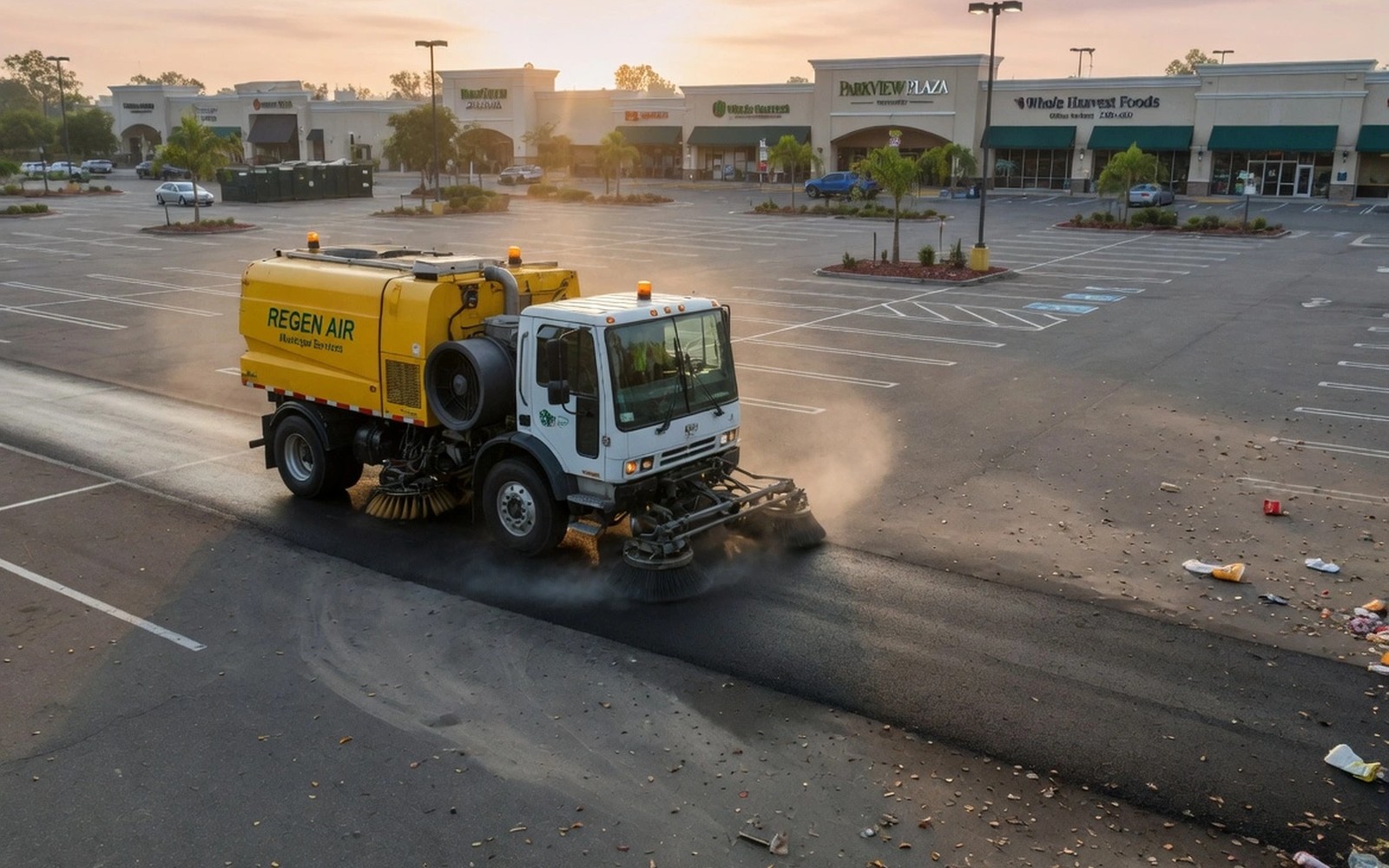
Street sweepers are heavy-use equipment. A municipal unit running two shifts on urban routes might accumulate 100,000 miles in five or six years. The hopper cycles thousands of times per year. Gutter brooms wear on every pass. Engines run hard, especially on regenerative-air units where the blower is running continuously. The mechanical life of a well-maintained municipal sweeper is roughly ten to twelve years for a regenerative-air unit and somewhat less for a mechanical broom machine on heavy urban routes.
The problem is that budget cycles and fleet replacement cycles do not sync up naturally. A department might be running seven sweepers, with three of them past the ten-year mark, but the capital budget only allows for one replacement per year. That means three years to replace the aging portion of the fleet. In the meantime, those older units are generating higher maintenance costs, more unplanned downtime, and potentially more stormwater compliance risk because older mechanical broom units may not meet current PM-10 standards.
Financing a multi-unit replacement or a fleet refresh compresses that timeline. Instead of replacing one sweeper per year for three years, a department can finance three units simultaneously, spread the cost over five years, and have a fully current, compliant fleet immediately. The annual payment is higher than a single unit's payment, but the maintenance savings and compliance assurance often justify the comparison.
Municipal lease-purchase terms for street sweepers typically run three to seven years. Shorter terms mean higher annual payments but lower total cost. Longer terms reduce the annual appropriation burden but increase the total amount paid. For departments on tight budgets, a five-year term on a new regenerative-air sweeper often balances payment size against total cost better than either extreme.
Tax-exempt rates on municipal lease-purchases are set by market conditions and vary based on the creditworthiness of the municipality and current interest-rate environment. In practice, the effective rate on a municipal lease-purchase is meaningfully lower than a commercial equipment loan rate, which matters over a five-year term on a $200,000 machine.
Some departments prefer a structure where they put a small down payment and finance the remainder, while others want to finance the full purchase price and preserve cash for operational needs. Both structures are available. End-of-term options range from $1 buyout (essentially a loan structured as a lease) to fair-market-value options that allow the department to return the equipment or purchase it at market value, which can be useful for departments that want fleet flexibility.
Equipment questions
Clear answers before the equipment file moves to review.
Most municipalities are required by their own procurement rules or state law to competitively bid purchases above a certain dollar threshold. However, many states have cooperative purchasing programs (such as HGAC, Sourcewell, or state-specific cooperatives) that allow municipalities to purchase equipment at pre-negotiated prices without a separate bid process. If your equipment is purchased through one of these co-ops, the financing can follow the same pathway without triggering a separate bid requirement for the financing itself.
The non-appropriation clause is standard in municipal lease-purchase agreements for exactly this reason. If the governing body fails to appropriate funds for the lease payment in a future fiscal year, the agreement can be terminated without financial penalty to the municipality. The lender would repossess the equipment, but no deficiency judgment would be pursued against the municipality. This is a well-established feature of municipal financing and most councils are familiar with how it works.
Yes. Small townships, villages, special districts, and even rural counties are entities we finance. Smaller municipalities may face slightly different rate structures than large cities because the credit profile is different, but the product is the same. A municipality that has been appropriating and paying its obligations on time is a good credit regardless of population size.
A lease-purchase structured to fit within your operating budget may be the answer. Some states allow municipalities to classify lease-purchase payments as operating expenses under certain structures, which means the appropriation can come from the operating budget rather than the capital budget. This is state-specific and depends on how the agreement is structured. We work with municipal finance attorneys to ensure the documents meet your state's requirements.
Keep exploring
Compare adjacent equipment, model, market, and service-area pages.
Equipment desk
Send the machine, seller, hours, and timing. The equipment desk will organize the next step.